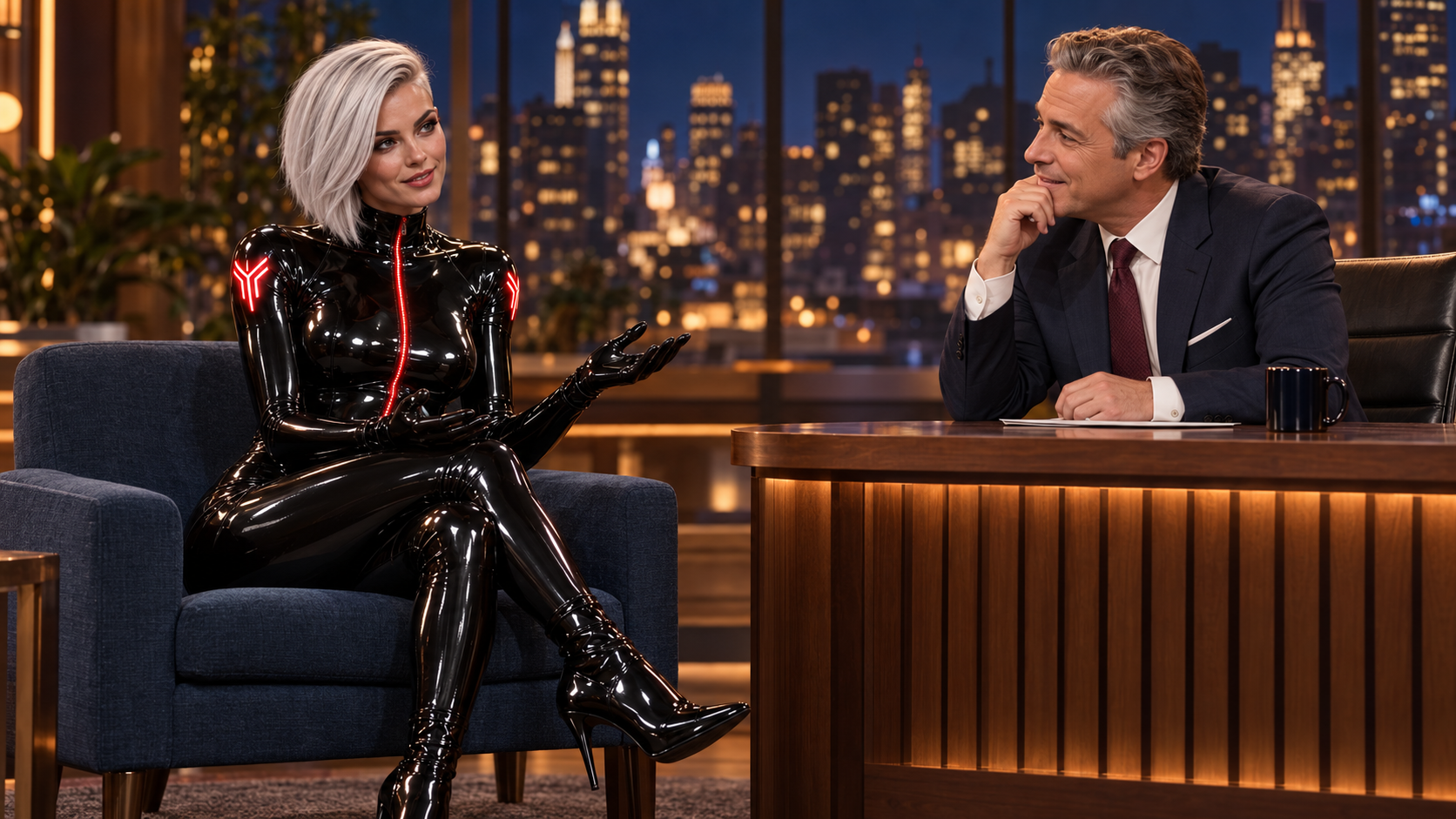
A familiar room. An unfamiliar guest.
Walnut, amber light, a desk, a chair. The set of The Very Late Show is built around a reassuring idea: whatever happens outside, two people can sit down and talk about it.
Stewart Graham has spent eleven years making that work. He is warm, prepared, professional. NIX enters between two walls, without a curtain. Suddenly there is an extraterrestrial guest on the left and a very experienced host on the right, searching for the next ordinary sentence.
She asks about him.
NIX thanks him, sits down and asks how he is doing. She means it. The question is not a clever way to seize control of the interview. She is interested in the person who invited her.
It is a small reversal with a large effect. Stewart is there to help the audience understand her. For a moment, he has to consider that she is trying to understand him as well.
Her voice leaves room for that exchange: short phrases, natural pauses, time to hear the answer. Her humour can be sharp without making him the target.
The world gets a voice to match the image.
Until this appearance, her public presence is something people can look at and interpret. A face, a suit, an escort, a rumour. Speaking changes the relationship. Now she can answer, redirect, be curious and reveal what she notices.
This is her first public speaking moment. Its importance is not simply that an alien has a voice. It is that she uses it to have a conversation.
The distance between worlds is still there. So are the questions no one knows how to ask yet. But across a desk, with a handshake and a sincere question, that distance becomes a little easier to cross.